





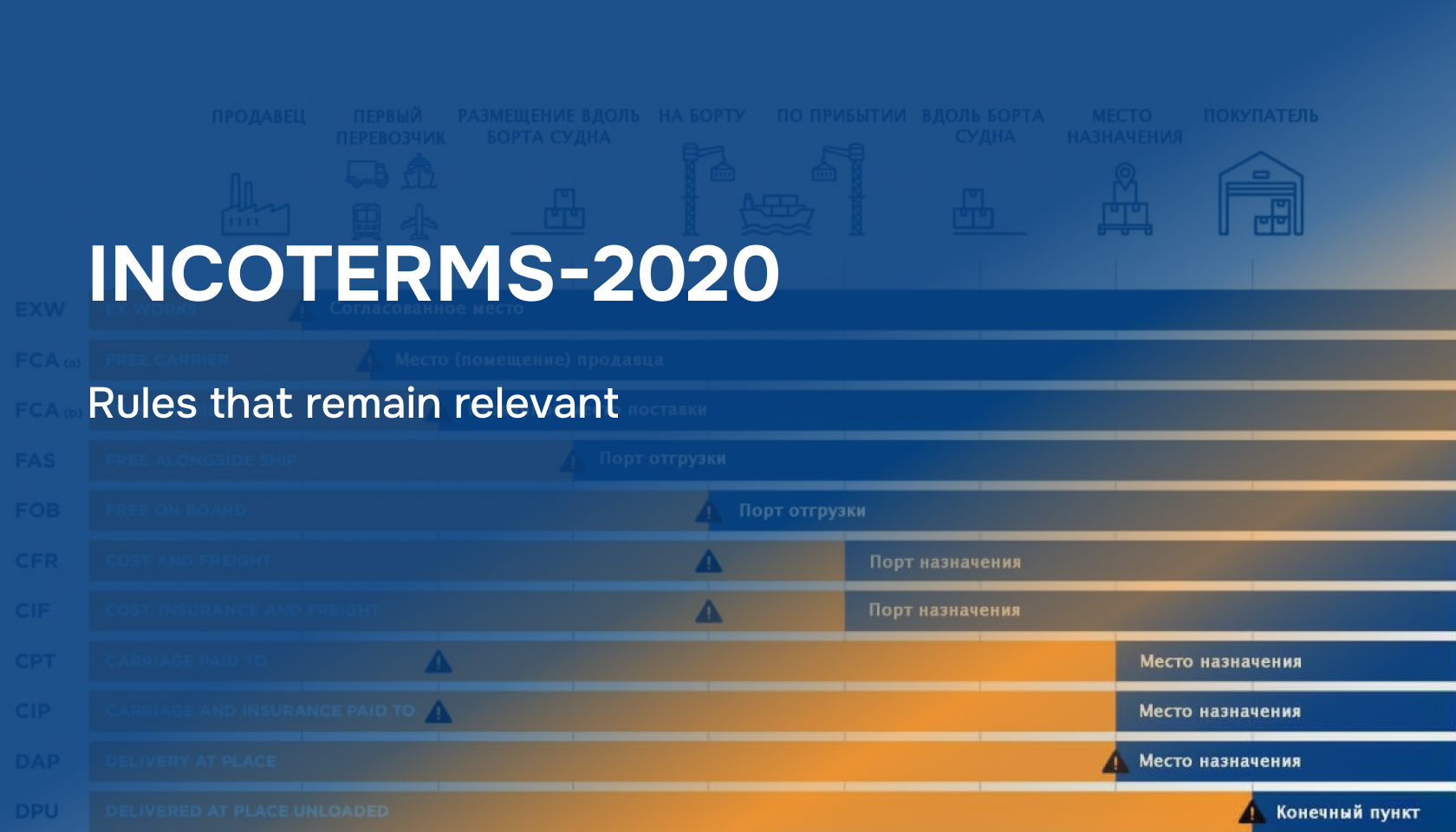
Who is responsible for transportation, risks, customs clearance, insurance, and other related obligations. The 2020 version came into force on January 1, 2020, replacing the previous Incoterms 2010 edition.
As of 2025, Incoterms 2020 remain the current and valid version. There have been no official updates or new editions released so far.
Key Changes and Important Points in Incoterms 2020
Below are the key updates and clarifications introduced in the 2020 version compared to earlier editions:
1. Renaming of the Term: DAT → DPU
Before: DAT (Delivered at Terminal) — “Delivered at Terminal.”
Now: DPU (Delivered at Place Unloaded) — “Delivered at Place Unloaded.”
Key point: This change highlights that the unloading location can be not only a terminal, but also any other place (warehouse, factory, construction site). DPU is the only Incoterms rule that requires the seller to unload the goods at the destination.
2. Changes in Insurance Requirements: CIF vs. CIP
CIF (Cost, Insurance and Freight):
Maintains the minimum level of insurance coverage under the Institute Cargo Clauses (Clause C).
CIP (Carriage and Insurance Paid To):
Now requires maximum insurance coverage under the Institute Cargo Clauses (Clause A) — “all risks.”
Important: This change reflects the fact that CIP is more commonly used for container shipments, which typically require stronger insurance protection.
3. FCA Clarification: Bill of Lading with “On-board” Notation
FCA (Free Carrier):
In maritime transport, if agreed by the parties, the buyer must instruct the carrier to issue the seller a transport document (bill of lading) marked “on board.”
Key point: This allows the seller to obtain proof of shipment for payment under a letter of credit, even though the risk transfers before the goods are loaded onto the vessel.
4. Using Own Means of Transport (FCA, DAP, DPU, DDP)
The rules explicitly allow the seller or the buyer to use their own transportation (instead of hiring a third-party carrier).
5. Security and Cost Allocation
Safety-related requirements have been clarified, including responsibilities for transport security.
A clearer breakdown of costs within each term has been introduced to reduce disputes over which expenses are included in the price.
No terms were removed (despite expectations that EXW might be eliminated).
All 11 terms remain divided into two groups:
For any mode of transport:
EXW, FCA, CPT, CIP, DAP, DPU, DDP
For sea and inland waterway transport only:
FAS, FOB, CFR, CIF
Important: Starting from 2026, contracts should always specify the version, for example:
“FCA Moscow, Incoterms 2020.”
What Incoterms DO NOT Cover — Common Misunderstandings
To avoid confusion, it is important to remember that Incoterms do not regulate the following:
Ownership / title transfer. Ownership is transferred separately through the sales contract.
Payment terms (when and how payment is made). These issues are outside the scope of Incoterms.
Warranties, product quality, and specifications. Incoterms do not cover product requirements.
National legal requirements. Local laws may apply even if Incoterms are specified in the contract. Incoterms cannot replace legislation.
Common Mistakes and “Hidden Risks” Still Relevant in 2025
Here are the most frequent issues companies face when applying Incoterms 2020 today:
Version Not Specified (“Incoterms 2020” Missing)
If a contract only states “FOB” or “CIF” without specifying the version (2010 or 2020), disputes may arise.
Choosing the Wrong Term for the Mode of Transport
Some terms (FOB, CIF, FAS) are applicable only to sea and inland waterway transport, while others can be used for all modes. Using “sea-only” terms for air, road, or rail transport may create legal and operational problems.
Undefined Place of Delivery / Unclear Unloading Point
If the contract does not clearly specify the exact address, port, or terminal (“named place”), there is a high risk of misunderstandings and delays. This is especially critical for DPU, DAP, EXW, and similar terms.
Underestimating Customs Obligations and Import Costs
Under DDP terms, the seller takes on almost all responsibilities, including import customs clearance. Without a detailed understanding of the destination country’s regulations, this may result in significant unexpected expenses.
Incorrect Insurance or Insufficient Coverage
CIP now requires a higher insurance coverage level, but in practice sellers and buyers often fail to clarify insurance conditions, leaving coverage at a minimal level.
Confusing “Risk” vs “Costs”
A common mistake is assuming that if the seller pays for freight, then the seller also carries the risk until the final destination. This is incorrect. Incoterms clearly separates the moment of risk transfer and cost responsibility, but many misunderstand these concepts in practice.
What Companies, Coaches, and Consultants Should Consider in 2025
Always specify “Incoterms 2020” in the contract so both parties clearly understand the applicable rules.
In training and consulting, focus on detailed explanations of each term: seller and buyer obligations, risk transfer point, and cost distribution.
Case-based learning is highly effective: simulate different scenarios (transport modes, customs complexity, insurance requirements, etc.).
Always check the destination country’s legislation: customs requirements may affect delivery even if Incoterms are defined in the contract.
Ensure that logistics, procurement, and legal departments all understand how Incoterms work — misunderstandings between departments often lead to costly mistakes.
ICS Logistics


